Whenever we travel through an airport, one question seems to come up again and again: Why is airport food so expensive? We’ve noticed that a simple coffee, sandwich, or bottle of water can cost noticeably more than what we would normally pay outside the airport. It made us curious about what actually causes these higher prices.
After looking into how airport restaurants operate, we found that there are several reasons behind the difference, including airport rents, concession fees, labor, security requirements, transportation, and the costs of operating inside a busy airport environment. In this guide, we’ll break down these factors and also share a few practical ways to spend less on food during your next trip.
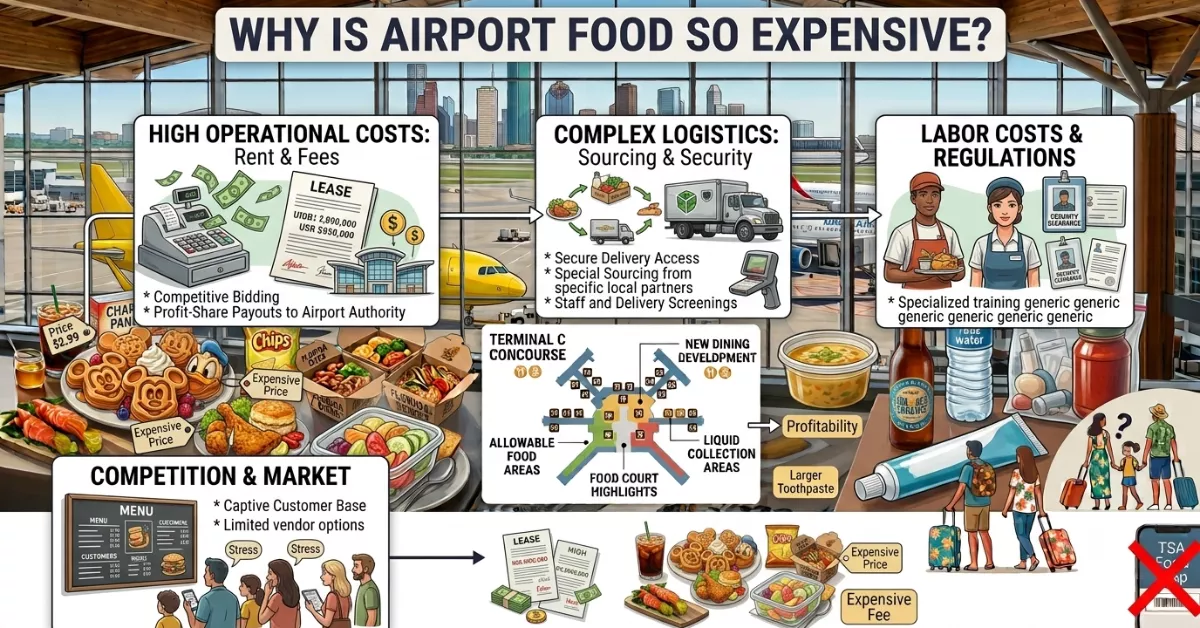
So, why is airport food so expensive? It is not usually because airports simply decide to charge more for every item. Several factors contribute to the higher prices, including airport rents, concession fees, staffing costs, transportation, security requirements, operating hours, and the limited number of places where travelers can buy food.
In this guide, we’ll explain why airport food costs more, how airport restaurants set their prices, whether all airport food is expensive, and how you can save money while eating at the airport.
Why Is Airport Food So Expensive?
Airport restaurants operate in a very different environment from restaurants on a normal city street.
A restaurant outside an airport can receive deliveries from suppliers, have employees arrive without going through airport security, operate during convenient hours, and compete with dozens of nearby restaurants.
Airport restaurants have additional costs and restrictions.
Some of the main reasons include:
- High airport rents and concession fees
- Security requirements
- Higher labor costs
- Limited delivery access
- Transportation and logistics
- Long operating hours
- Limited competition within secure areas
- Airport operating and infrastructure costs
- Higher costs for certain supplies
These expenses can eventually be reflected in the prices customers see on the menu.
Do Airports Charge Restaurants Higher Rent?
Yes, airport restaurants generally operate under commercial agreements with airports or airport concession operators, and the costs of operating in an airport environment can be substantial.
Airports may lease space to concessionaires through leases, licenses, or concession agreements. Depending on the airport and agreement, operators may pay rent, percentage-based fees based on sales, or other charges.
The restaurant then has to recover its operating expenses while still making a profit.
For travelers, this can mean that a restaurant inside an airport has a different cost structure from the same restaurant operating in a shopping center or downtown location.
Why Is Airport Rent So Expensive?
Airport space is valuable because travelers have limited alternatives once they enter the secure area.
An airport restaurant may have access to a large number of passengers passing through every day, but it also has to operate within a highly controlled environment.
The restaurant is not simply paying for four walls and a kitchen. Its operating agreement can involve additional costs associated with the airport, common areas, infrastructure, utilities, concession management, and other requirements.
Those costs can contribute to higher menu prices.
Check Here: Las Vegas Airport Food
Do Airport Restaurants Have Higher Labor Costs?
Labor is another important factor. Airport employees may need additional security clearance or identification to work in restricted areas. Depending on the airport, employees may also have to follow special procedures when entering and leaving secure areas.
Airport restaurants may also operate for long periods because flights depart throughout the day.
A restaurant might need employees very early in the morning and late at night, even when passenger traffic is not evenly distributed throughout the day.
Higher staffing requirements and operating complexity can increase the cost of running the restaurant.
Why Does Airport Food Cost More to Deliver?
Getting supplies into an airport is more complicated than delivering them to an ordinary restaurant.
Airport suppliers and restaurant employees have to follow security and access procedures. Deliveries may also need to be coordinated around airport operations.
In some airports, goods cannot simply be unloaded directly at the restaurant’s back door in the same way they can at a typical street-side business.
Food, beverages, packaging, kitchen supplies, cleaning products, and other materials all have to reach the restaurant.
Additional transportation and handling costs can therefore become part of the restaurant’s overall operating expenses.
Does Airport Security Make Food More Expensive?
Security is not normally a separate charge added to your sandwich or coffee, but airport security requirements can increase the cost of operating a business.
Restaurants inside secure areas have to work within airport security procedures.
Employees, suppliers, equipment and deliveries may all be subject to access controls. Moving products and supplies around an airport can therefore take more planning than moving them around a conventional commercial property.
These additional operational requirements can contribute to the overall cost of airport dining.
Why Is a Bottle of Water So Expensive at an Airport?
Water is one of the most noticeable examples because a bottle that costs relatively little outside an airport can be considerably more expensive inside the terminal.
The water itself is not necessarily more expensive to produce.
The price can reflect:
- Airport concession costs
- Retail space costs
- Transportation
- Labor
- Operating expenses
- Packaging
- Business overhead
- The convenience of buying inside the terminal
Travelers also have fewer alternatives after passing through security, particularly if there are no free water refill stations nearby.
A reusable bottle can therefore be useful. Many airports provide drinking fountains or bottle-filling stations after security.
Is Airport Coffee More Expensive?
Airport coffee can also cost more than coffee from a location outside the airport.
A cup of coffee includes more than the cost of beans, milk and the cup. The business must also cover employee wages, rent, equipment, utilities, supplies and other operating expenses.
Airport locations can have higher overhead costs, which may be reflected in the final price.
However, airport prices can vary significantly. A coffee at one airport may cost very differently from a coffee at another airport.
Are Airport Restaurants More Expensive Than Regular Restaurants?
Often, yes, but not every airport restaurant is dramatically more expensive.
Prices depend on the airport, terminal, restaurant, brand, city and type of food.
For example, a national fast-food chain may have a relatively predictable menu structure, while an independent airport restaurant may have completely different pricing.
Premium restaurants, sit-down dining and specialty concepts can naturally cost more than quick-service restaurants.
So it is better to think of airport food as a range of prices rather than one universal airport markup.
Check Here: Atlanta Airport Food Guide
Does Every Airport Charge More for Food?
No.
Airport food prices vary considerably between airports.
Large international airports in expensive cities may have very different operating costs from smaller regional airports.
The airport’s concession structure, local labor market, restaurant brands, passenger volume, terminal layout and competition can all affect prices.
Some airports also have programs intended to keep concession prices closer to those found outside the airport.
For this reason, you should not assume that every restaurant inside every airport will have the same level of markup.
Why Is Food More Expensive After Security?
Food after security can sometimes feel particularly expensive because travelers have fewer alternatives.
Once you pass through the security checkpoint, you may have limited access to restaurants and shops outside the airport.
If your flight is boarding soon, you also have less opportunity to leave the terminal and search for a cheaper meal.
This creates a convenience factor.
You are not only paying for the food—you are also paying for the ability to buy it where and when you need it.
Does Airport Location Affect Food Prices?
Yes.
An airport located in a major metropolitan area with high commercial rents and labor costs may have different restaurant prices from an airport in a smaller city.
For example, food prices at a major international airport in New York, Los Angeles, London or another expensive city may differ substantially from those at a smaller regional airport.
The cost of living and doing business in the surrounding area can therefore influence airport restaurant prices.
Why Is Airport Food Expensive During a Layover?
Passengers with long layovers can be especially affected because they may need to buy food inside the airport.
Imagine you have a three-hour connection. Leaving the airport, finding a restaurant and returning through security may not be practical.
The airport becomes the convenient option.
Restaurants know that travelers value convenience, particularly when they are tired, unfamiliar with the city or working with a limited amount of time.
That convenience is one reason airport dining can feel expensive.
Are Airport Restaurants Allowed to Charge Whatever They Want?
Airport restaurants do not necessarily operate without restrictions.
The exact rules depend on the airport and its concession agreements.
Some airports have pricing requirements, consumer-protection provisions, or agreements intended to prevent unreasonable pricing. Others use different concession models.
For this reason, it is worth checking the specific airport’s concession policy if you are researching food prices at a particular airport.
There is no single pricing rule that applies identically to every airport in the United States.
How Can You Save Money on Airport Food?
You do not necessarily have to spend a lot on food before every flight.
Here are some practical ways to reduce your airport food bill.
Eat Before Going to the Airport
One of the simplest ways to save money is to eat a proper meal before leaving for the airport.
You can then buy only a coffee or snack if you become hungry later.
Bring Allowed Snacks
Solid snacks such as crackers, granola bars, nuts, sandwiches and other permitted foods can often be carried through airport security.
This can be particularly useful for long travel days.
For security rules, always check the current requirements for the specific food you plan to bring.
Carry an Empty Water Bottle
An empty reusable bottle can generally be taken through airport security. You can then fill it after security where bottle-filling stations or drinking fountains are available.
This can help you avoid buying bottled water every time you travel.
Compare Restaurants
Don’t automatically choose the first restaurant you see.
If you have enough time, look at menus from several restaurants in your terminal. Prices can vary even when restaurants are located close to each other.
Look for Food Courts
Airport food courts can provide several choices at once and may include less expensive quick-service options alongside more expensive sit-down restaurants.
Check the Airport’s Restaurant Directory
Before traveling, check the airport’s official dining page.
This lets you see which restaurants are available in your terminal and can help you decide where to eat before arriving.
Is Airport Food Worth the Extra Cost?
That depends on your situation.
If you have a long layover, an early flight, a delayed flight or a tight connection, buying food at the airport can be the easiest option.
For someone with plenty of time and access to restaurants outside the airport, eating before arriving may be cheaper.
The higher price does not necessarily mean the food is better or worse. It often reflects the different costs and convenience associated with operating and buying food inside an airport.
Check in Video
Final Thoughts
Airport food is often expensive because running a restaurant inside an airport is different from running one on a normal city street. Rent and concession costs, labor, security procedures, transportation, logistics, operating hours and limited access can all contribute to higher prices.
That does not mean every airport restaurant is overpriced or that every airport has the same pricing structure. Prices vary considerably depending on the airport, restaurant and local operating conditions.
If you want to keep your travel costs down, eating before arriving, bringing permitted snacks, carrying an empty reusable water bottle and comparing restaurant prices can make a noticeable difference. When you do buy food at the airport, you’re often paying not just for the meal but also for the convenience of having it available when you’re traveling.
Check Here: Seattle Airport Food Guide